
Charles de La Portbarré
Client & Distribution Intelligence
Every Client counts. Some more than others.
I read your sales history, direct (B2C) and through your distributors (B2B), and tell you who to retain, who to grow and who to reactivate.
Fine wine & luxury · 15 years' experience · Chanel & Richemont · Europe & APAC
 Let’s talk
B2C Clienteling: your direct Clients
Beyond your best Clients, some are ready to buy again and others are waiting to be won back. Past a certain number of Clients, there is simply no keeping track of them by hand.
Reading a Client portfolio: an example
A good year: both your year-end numbers are up, and nothing seems to call for attention.
The same numbers, opened up to act on.
Illustrative example, fictional data.
- Behind the “+20%” in Client numbers, 39 Clients slipped away without anyone noticing, while your most loyal ones are simply waiting to trade up.
Example: Domaine Belargus (Loire)
- The question. Sales are growing. But is the Client base renewing itself, or becoming loyal?
- The finding. Loyal Clients stay. It is the new Clients who don't come back often enough.
- The lever. Those who come back have had several occasions to connect with the estate.
- The actions. An early follow-up purchase occasion, and an event designed for new Clients.
He knows wine and our trade as well as he knows data.
"When Charles arrived, our Client data was scattered across several files that weren't linked to each other. I sensed there was something to be drawn from it, but I didn't really know how we'd go about it. He took the whole thing on himself, with minimal effort on our side. His real strength is that he knows wine and our trade as well as he knows data: he applied to an estate like ours the Client tracking methods used by the great luxury houses. What came out was a clear read of our Clients: who comes back year on year, who moves up the range, who to rely on to build the brand, with concrete actions attached. Even if we had been able to devote a great deal of time to it, I'm convinced we would never have reached the same level of information and quality of analysis."
B2B Distribution: your négociants and distributors
A château sells through dozens of négociants, distributors and importers. Each sees its own Clients; nobody sees the whole picture.
Example: Domaines Jacques Thienpont
- Reconcile. We prepare the file sent to the négociants, then consolidate what comes back, so that the same Client is recognised under different names (“Fine Food and Wines HK Limited” and “FFWHK”, for instance).
- Analyse. Many Clients turn out to be served by several négociants at once.
- Measure exclusivity. For each négociant, the share of its Clients that no one else serves.
- Prepare the discussion. A report giving a complete picture of how well the distribution performs, and a sheet for each négociant with everything worth having to hand in the meeting.
Some high-volume négociants sell mostly to Clients who are already served elsewhere.
Sample négociant fact sheet
Fictional example, invented names.
120
bottles allocated
36
in stock
84
sold
4 / 11
exclusive Clients
| Client at risk | Country | Bottles | Also served by |
|---|---|---|---|
| Georthur Fine Wines | Hong Kong | 18 | Négociant 03, Négociant 21 |
| Aldbury & Crane Cellars | United Kingdom | 12 | Négociant 07 |
| Maison Arthuges | Switzerland | 12 | Négociant 03 |
| Tanjong Reserve Cellars | Singapore | 6 | Négociant 07, Négociant 21 |
Our request: these Clients are already served by other négociants. For the next campaign, could you find new ones?
I now go into my annual discussions with our négociants in a much more pragmatic way.
"I now go into my annual discussions with our négociants in a much more pragmatic way: for each one, I have a clear sheet and, behind it, a complete file bringing all their reports together. It is work we had never been able to do. Each négociant sends us their sales in their own format, sometimes as a PDF, and recognising the same Clients behind different names takes both data rigour and a fine knowledge of wine distribution. Those two skills are rarely found in the same person. This exhaustive analysis of the data gives an overall view of distribution by négociant, by each négociant's Clients, by volume and by country, and also shows how granular the sales work has been. It provides the tools to make the right commercial decisions, with very precise targeting."
Method: manage your Clients with intent
| Phase | B2C · Clienteling | B2B · Distribution |
|---|---|---|
| See | Client portfolio dynamics: new, retained, reactivated, lost, and the engagement matrix. | Reconciling distributor / négociant reports and measuring exclusivity. |
| Pass on | Your team learns to run these analyses itself, on your own data. | A template your team reuses and updates each period. |
| Support | Monthly or quarterly, actions taken Client by Client, with their effect measured. | Distributor / négociant sheets brought up to date before every allocation or target review. |
Confidentiality: your data stays with you
Your data reaches me pseudonymised and under NDA. In B2B, the key linking codes to distributor / négociant names never leaves your office.
Equally at home in hospitality and luxury
The same method holds for any house whose Clients come back.
He precisely measured how a change in our menu affected our net margin.
"As a restaurant, we don't have a team dedicated to IT or data. Charles helped us download and prepare the data, then worked autonomously. On top of the Client analysis, he precisely measured how a change in our menu affected our net margin. His ability to tailor his approach to our needs and our systems delivered concrete actions on our side."
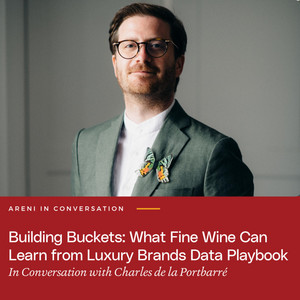
A guest of Areni Global, the world reference in fine wine
Building Buckets: What Fine Wine Can Learn from Luxury Brands' Data Playbook
Who I am.
Fifteen years reading Client databases across Europe and Asia, notably at Richemont and for five years at Chanel in Hong Kong. Mathematician, agri-food engineer, WSET 3 and French Wine Scholar… and, happily, the grower of 150 Pinot Noir vines in Saint-Malo, Brittany.
Heard on the Areni Global podcast Read my full background
Let's talk about your Clients: one conversation is enough to see what your data reveals.
A first conversation, no strings.